
Gujarat
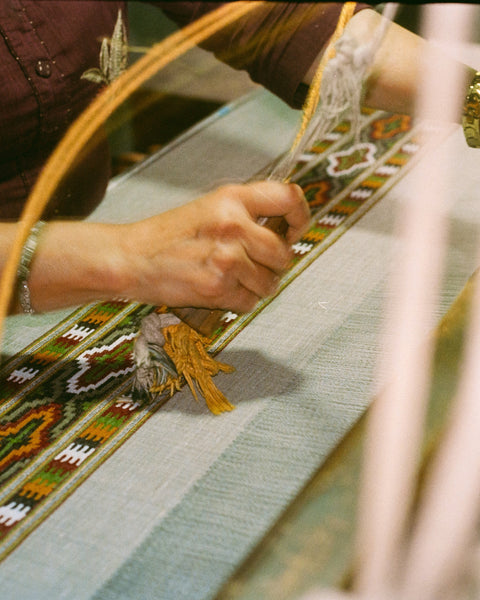


Gujarat has a long and varied history of textile making. Across the state, weaving, dyeing, printing and embroidery have developed alongside the communities that practise them, with techniques and knowledge passed down through generations. In Kutch, where much of this work is concentrated, textiles are closely connected to the landscape and to the people who have lived and worked there.
Kutch is a dry region, marked by large stretches of open land, seasonal changes and a strong relationship with its natural resources. Its textile traditions have developed within these conditions. Cotton, wool, natural dyes and locally available materials have historically been used to make cloth suited to the region, while different communities have developed their own methods of weaving and printing.
For our first collection, we worked across three different textile centres in Gujarat: Patan, Bhujodi and Ajrakhpur. Each is associated with a different process and history. In Patan, we worked with Mashru; in Bhujodi, handspun and handwoven khadi cotton; and in Ajrakhpur, Ajrakh, a traditional process of block printing and natural dyeing.
PATAN
Patan has a long history of Mashru weaving. Mashru is a fabric in which the warp is silk and the weft is cotton, creating a lustrous silk surface while keeping cotton against the skin. Historically, the fabric was developed in response to religious restrictions around silk within parts of the Muslim community. It offered a way to enjoy the appearance of silk without having it directly touch the body.
Artisans use a satin weave in which the silk threads float across the surface of the cotton, creating the characteristic sheen on one side and a soft cotton back on the other. The fabric also travelled beyond Gujarat and is believed to have been exported through wider trade networks, including to the Ottoman Empire.
Today, very little of this tradition remains. Only around four or five families continue to handweave Mashru in Patan. The rising cost of silk and reduced demand for handloom Mashru have made the original silk-and-cotton fabric increasingly difficult to sustain. The few families continuing the practice now largely work with viscose and cotton instead.
The Mashru used for the collection was sourced from a multi-generation Khatri weaving family in Patan, one of the very few families still working with the handloom tradition. The trousers made from the fabric retain the distinctive contrast between the lustrous outer surface and the softer cotton interior.


BHUJODI
Bhujodi is a historic weaving village near Bhuj, known for its handloom community and generations of weavers. We sourced the khadi cotton used in the collection from a handloom centre here, where the cloth continues to be made through a largely manual process.
Khadi begins with cotton being spun into yarn and then woven by hand on a handloom. Unlike mill-made cloth, where the process is mechanised and designed to produce consistency, handloom weaving leaves small variations in the yarn and the surface of the fabric. The texture, weight and character of the cloth are shaped by the person working the loom.
Khadi also carries a particular history in India. During the Swadeshi movement, handspun and handwoven cloth became closely associated with the rejection of imported textiles and with self-reliance. It came to represent not only a way of producing cloth, but an economic and political idea centred around local production and the people who made it.
In Kutch, this history intersects with an older relationship to cotton. The region is home to Kala Cotton, an indigenous variety that has been cultivated locally for generations. Naturally rain-fed and well suited to the dry climate of Kutch, it remains an important part of the region's relationship with cotton.
The fabric we worked with was handspun, handwoven and naturally dyed. The yarn has its own variations, the tension of the handloom changes subtly through the weave, and the dye settles differently across the surface. These differences remain visible in the finished textile.
There is something very direct about seeing a handloom at work. The fabric is produced gradually, with the movement of the loom and the repetition of the weaver's hands determining its pace. It is a very different way of thinking about cloth from an industrial one, where a finished length can be produced almost entirely removed from the person making it.
Bhujodi continues to have a strong community of artisan families working with these traditions, while also adapting the technique to contemporary textiles and clothing.
For AṂSA, it was important that the khadi remain recognisable as a handwoven material. The slight irregularities of the cloth, its softness and its texture are part of what gives the finished garments their character. The jacket and trousers made from the Bhujodi khadi carry these qualities into a contemporary silhouette without trying to remove the evidence of how the fabric was made.


AJRAKHPUR
Further within Kutch is Ajrakhpur, a village closely associated with the Ajrakh printing tradition. Here, we worked with an eighth-generation Ajrakh printing family whose practice has been carried through their family for generations.
Ajrakh is a traditional method of block printing and dyeing that involves a long sequence of preparation, printing, resist work, dyeing and washing. The process is generally made up of around eight stages, and each stage has to be completed carefully before the next can begin.
The cloth is first washed and prepared so that it can properly receive the dyes. Wooden blocks are then used to print different parts of the design onto the fabric. Resist is applied to areas that need to remain protected from a particular dye, allowing the colours to be built up gradually. The fabric is washed and dyed repeatedly, with each stage revealing another layer of the pattern.