
Himachal Pradesh
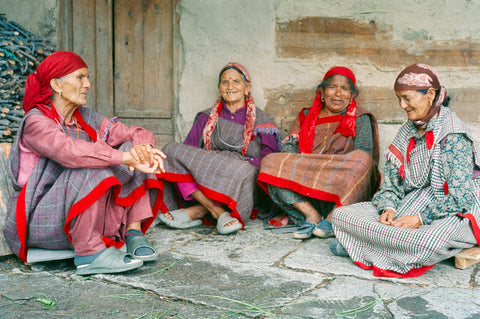

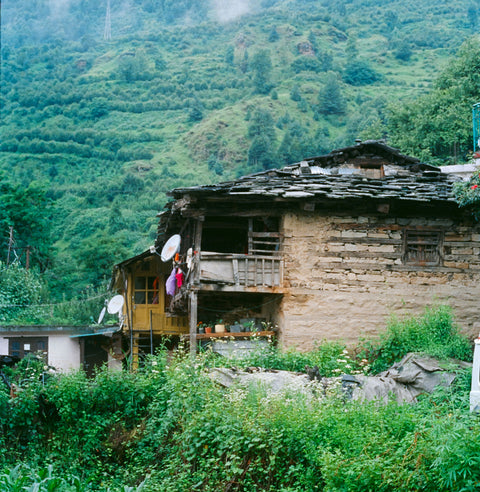

The Kullu Valley lies in the western Himalayas, following the Beas River through a landscape of steep mountains, forests and high-altitude villages. The climate here has always shaped the way people live and make. Winters are long and cold, and wool has been an important material in the region for generations, produced from sheep raised across the mountains and worked into clothing and textiles suited to the conditions.
The relationship between the landscape and textile making is particularly visible in Kullu. Wool is not an imported material brought into the region for production; it begins within the local environment. Indigenous Himalayan sheep breeds graze freely across mountain pastures at altitudes of roughly 3,000 to 5,000 metres, moving with the seasons under the care of shepherds from semi-nomadic communities such as the Gaddi, who traditionally take their flocks up to alpine meadows in summer and down to lower valleys in winter. Raised in the open rather than in confined farming systems, these sheep develop a dense fleece that protects them from the cold — heavy, naturally insulating and, by design, tougher and coarser than the fibre of commercially farmed breeds such as merino. Once the wool is collected and prepared, it becomes part of a much longer process of spinning, weaving, knitting and finishing, carried out by skilled makers
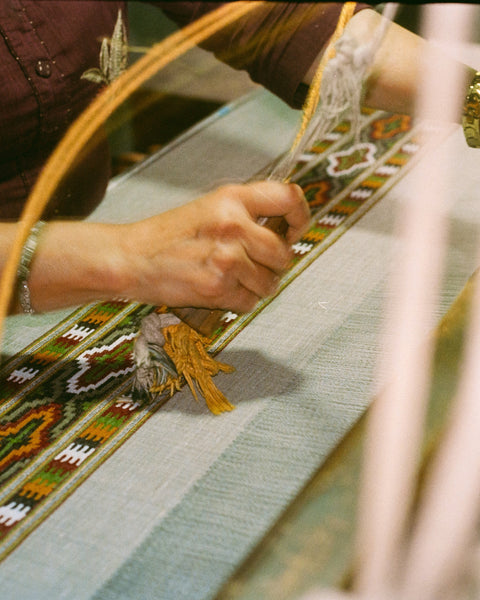
Kullu is best known for its handloom traditions, most visibly expressed in the Kullu shawl, or pattu. Woven on vertical frame looms, the shawl's body is traditionally worked in plain, twill or fine zigzag weaves, while its identifying feature is the border: bands of vivid, contrasting colour carrying geometric motifs — diamonds, triangles, stars and stylised florals — set against the otherwise plain, earth-toned body of the cloth. This particular combination is a relatively recent development: early Kullu weaving by the local Kulivi community produced largely plain, undecorated shawls, and it was only with the arrival of weavers from the Kinnaur and Bushahr regions — accounts place this migration anywhere from the early nineteenth century to the 1940s — that the region's now-signature geometric borders and bright, multi-coloured palette were introduced and adopted into local practice. Traditional Kullu textiles are recognised for these geometric patterns, bands and borders, and for their use of strong, contrasting colours, but beneath these recognisable features is a much simpler relationship with the material: wool is transformed into cloth through a process that remains closely connected to the hands of the person making it.
For this collection, we were interested in the wool itself and in retaining its connection to Himachal Pradesh. The garments are made from 100% indigenous wool sourced from the region, without blending it with merino or other imported fibres. This was a deliberate choice. Rather than changing the character of the local wool to make it resemble a finer or more familiar fibre, we wanted to work with its natural qualities — its thickness, warmth, density and texture.


For this collection, we were interested in the wool itself and in retaining its connection to Himachal Pradesh. The garments are made from 100% indigenous wool sourced from the region, without blending it with merino or other imported fibres. This was a deliberate choice. Rather than changing the character of the local wool to make it resemble a finer or more familiar fibre, we wanted to work with its natural qualities — its thickness, warmth, density and texture.The wool produced in the Himalayan climate has a naturally insulating quality, a direct result of the altitude and cold in which the animals are raised. The fleece is dense and resilient, suited to the conditions in which the sheep live outdoors year-round. Once worked into yarn, it retains a fullness and weight that gives the finished garments a particular presence. It is not perfectly uniform, and the surface carries subtle variations that come from the fibre itself and from the process of working it by hand.
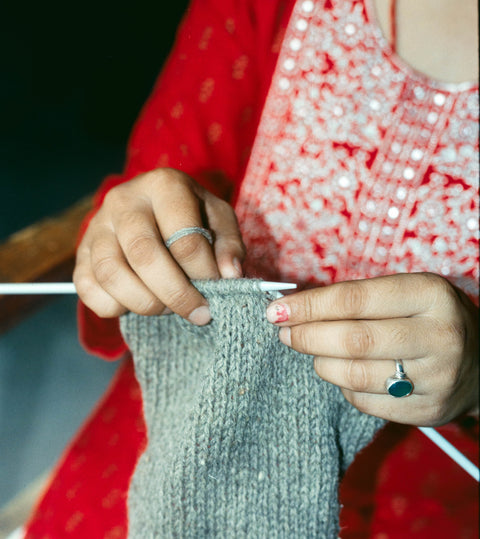
The sweaters are entirely hand-knit, hand-stitched and hand-finished. Unlike a garment produced from industrially knitted fabric and subsequently cut and assembled, the sweater takes shape gradually through the repeated movement of the hands. Each stitch contributes to the structure of the garment, while the stitching and finishing bring its different parts together.
The work is carried out by women from the local community, and what was particularly striking was the sense of community between the artisans themselves. The making was not an isolated process carried out by individuals, but something shared between women who work alongside one another, exchange knowledge and support each other through the process. It was a community in a very true sense.
Supporting these women is also a way of helping preserve traditional crafts of the Himalayas while creating greater economic independence within the local artisan community. By enabling them to continue practising and passing on these skills, the craft remains part of the community rather than becoming something preserved only as a tradition of the past.
The coat is made from the same indigenous wool. In a larger, more structured garment, the density of the fibre becomes particularly apparent. It gives the coat weight and warmth while retaining the natural texture of the wool. The material does not feel detached from its origin — it still has the fullness and irregularity of the fibre that came from the sheep.
Working with indigenous wool was also a way of looking at what is already available within India's textile traditions. Contemporary knitwear often relies on imported fibres or blends selected for their softness, fineness or uniformity. Indian wool is less frequently positioned in this way, despite the country's long history of wool production and textile making across its Himalayan regions — a history that continues to sit alongside state efforts to crossbreed local sheep with finer-fibred imported breeds in pursuit of softer, more commercially standard wool.7
The choice to leave the wool unblended was therefore important. There was no intention to refine it into something it was not. Its slightly rougher character, its weight and its natural variation are part of the material, and part of what makes the garments specific to where they were made.
The work also sits within a larger textile culture in Kullu that has continued to adapt over time. Traditional knowledge has not remained fixed to a single type of textile or garment. Makers continue to work with established techniques while responding to changing materials, forms and ways of dressing. This movement between what has been inherited and what is being made now is part of the life of the craft.
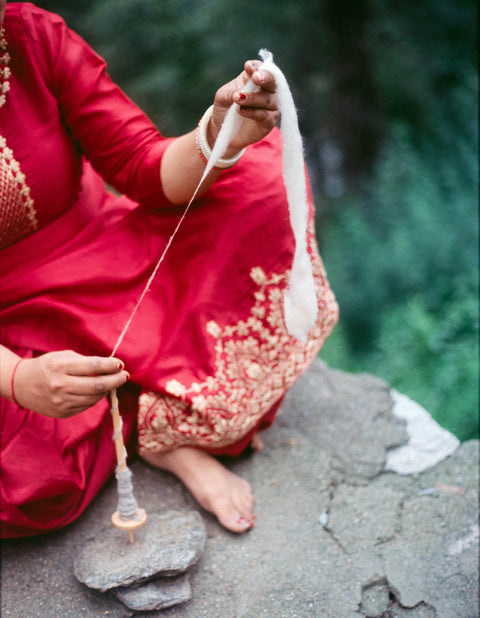

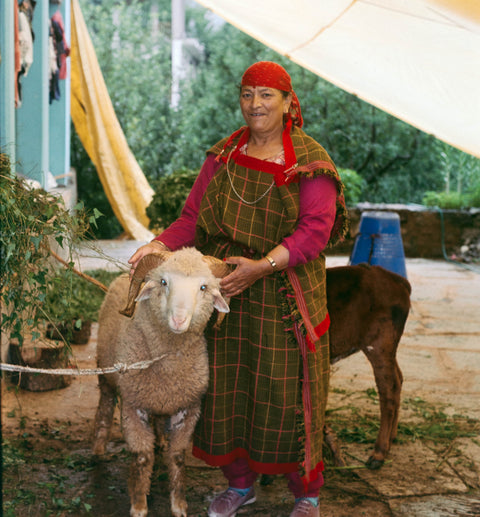

What interested us in Kullu was this directness between place, material and making. The wool begins in the landscape of Himachal Pradesh, is prepared and worked by hand, and eventually becomes clothing. Each stage leaves something behind: the quality of the local fibre, the way it has been handled, and the small variations that come with a process carried out by hand.
The sweaters and coat are made with that relationship in mind. They do not attempt to disguise the character of the indigenous wool or separate the finished garments from the process through which they came into being. The material remains warm, dense and tactile, with the traces of its making left visible.
In this sense, the garments are as much about the wool as they are about the finished form. They carry something of the climate, the landscape and the people who continue to work with the material in the Kullu Valley.