
Uttar Pradesh
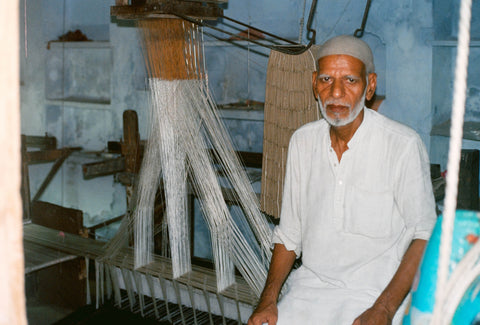

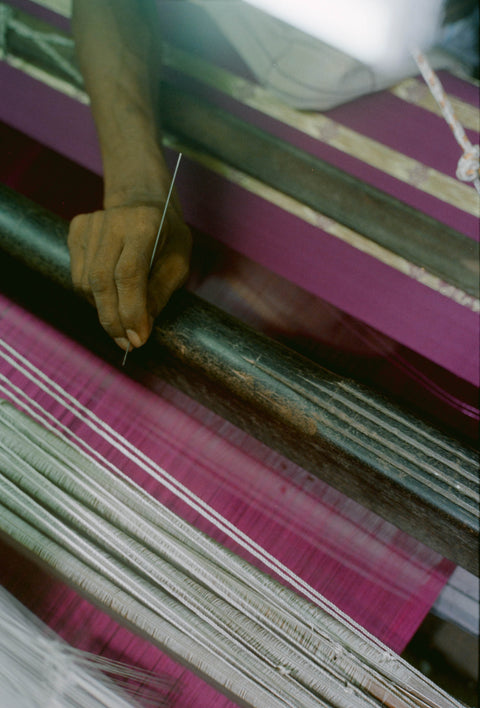

Uttar Pradesh has long been an important centre for textile making and embroidery, with different regions developing their own techniques, materials and ways of working. For this collection, we worked across two cities: Banaras, known for its silk and zari weaving, and Lucknow, where Chikankari has been practised for generations.
BANARAS
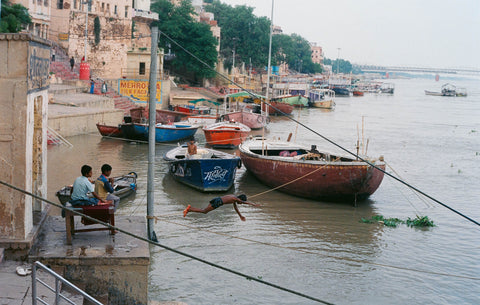
Banaras, also known as Varanasi, is one of the oldest continuously inhabited cities in the world and one of India's central spiritual centres. It lies at the heart of Indic faith and is deeply sacred to Hindus, who believe it to be the ultimate place for achieving moksha, or liberation from the cycle of life and death. The city is defined in many ways by its ghats, the steps leading to the Ganges, where people come to bathe, pray and cremate their dead. Alongside the temples, narrow lanes and markets, these rituals have shaped the character of the city over centuries.
There is a particular sense of contrast to Banaras. The quiet of the river at dawn sits alongside the movement of everyday life; old, worn architecture exists alongside signs of a changing city. It is a place where the past remains present without the city itself standing still.
This sense of continuity is also reflected in Banaras's textile traditions. The city has been a centre of silk cultivation and weaving since as early as the sixth century BCE, when the surrounding land's mulberry cultivation made it a natural base for the trade. Over time, techniques developed through the movement and exchange of different communities and influences, and the city became particularly known for Banarasi silk, where fine silk is woven together with zari to produce fabric with a distinctive lustre.


Zari itself is a metallic yarn, historically made by drawing fine wire from gold or silver and flattening it before winding it around a silk core; today it is more commonly produced with metal-coated polyester thread. Woven directly into the body of the fabric rather than embroidered onto its surface afterward, zari is what gives Banarasi textiles their characteristic shine and weight.
For this collection, we worked specifically with Banaras tissue silk. Tissue is a lightweight fabric created by weaving silk together with a significant amount of zari. The zari is introduced directly into the weaving process, creating a surface that catches and reflects light. The resulting lustre can resemble the finish of a machine-made fabric, but here it is achieved entirely through the construction of the cloth and a technique particular to the region.
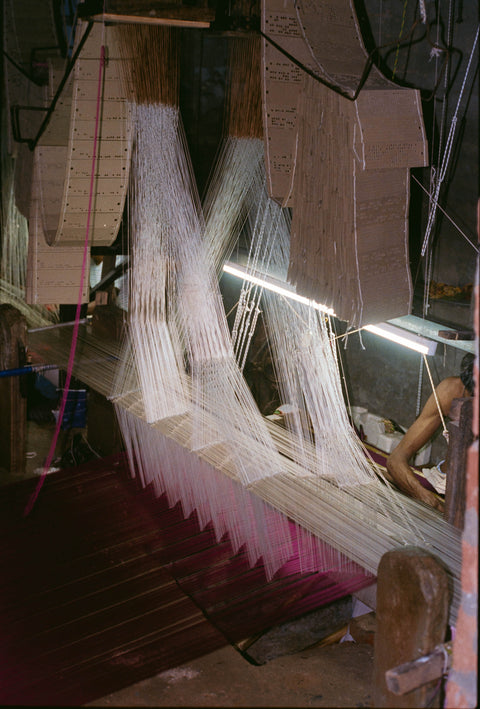
The history of Banarasi weaving is generally traced to the Mughal period. Historical accounts suggest that weavers from Gujarat migrated to Banaras following a famine in the early seventeenth century, bringing silk brocade techniques with them, and that the craft developed further in scale and refinement over the following two centuries. Under Mughal patronage, particularly during the reign of Akbar, Persian design sensibilities merged with existing Indian weaving practices, introducing motifs such as scrolling vines and symmetrical florals alongside the increased use of gold and silver zari. On the loom, this design information is still encoded mechanically: a jacquard mechanism, controlled by a sequence of punched cards, determines which warp threads are raised or lowered as the weaver passes the shuttle carrying silk and zari through by hand. In its most intricate form, known as kadwa, each motif is built up using individual bobbins so that the design sits as a distinct, self-contained unit within the weave.
We sourced our Banaras tissue from a multigenerational weaving community that has been practising the craft for five generations. The fabrics are entirely handloom and handwoven, using pure silk combined with high-quality zari. Working on the handloom allows the relationship between the two materials to remain visible in the finished cloth — the softness and movement of the silk alongside the reflective quality of the zari.
Our interest was not in reproducing the textile in its most familiar form, but in understanding what makes it distinctive and allowing those qualities to inform a contemporary silhouette. The tissue carries its history directly within its construction: its lightness, metallic surface and movement come from the way silk and zari are woven together.


LUCKNOW
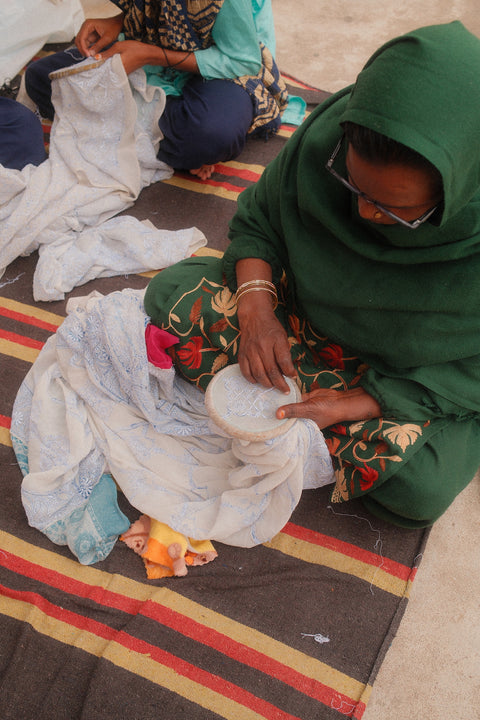
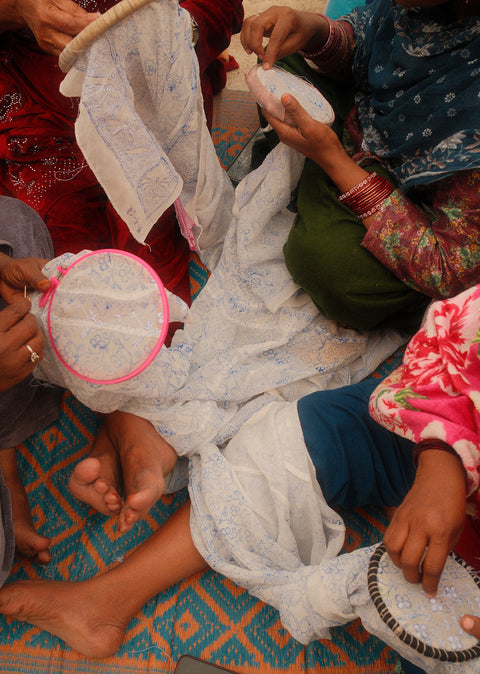
Lucknow is closely associated with Chikankari, a form of hand embroidery traditionally worked on fine fabrics such as muslin, organza and linen. Traditionally, it is done with white thread on white cloth, allowing the intricacy of the stitching to become visible through the surface of the fabric rather than through colour — an effect sometimes described as "white-on-white" or shadow work.
The craft's precise origins are debated. Some accounts trace embroidery of this kind in India back as far as the third century BCE, while others credit its introduction to Lucknow to the seventeenth-century Mughal court, with some crediting Empress Nur Jahan for bringing the technique from Persia. What is better documented is its rise under the Nawabs of Awadh through the eighteenth and nineteenth centuries, whose patronage allowed the craft to reach a high level of refinement, with entire artisan neighbourhoods coming to specialise in particular stitches. Chikankari now holds Geographical Indication status, formally recognising Lucknow as its home region.
Chikankari draws on more than thirty distinct hand-stitching techniques, with individual textiles usually combining several. Among the best known are tepchi, a running stitch used as a base for other stitchwork; bakhia, a shadow-work stitch worked from the reverse of the fabric so the thread shows through faintly on the front; murri, a raised, rice-grain-shaped knot used to fill the centres of floral motifs; and jali, an openwork technique in which the threads of the fabric itself are gently parted and secured with fine buttonhole stitches to create a net-like effect, without the working thread ever passing through to the back. Many of the motifs — florals, paisleys and trailing vines in particular — carry Persian and Mughal influence, and echoes of the same patterns can be found in the architecture and interiors of the region's mosques and monuments.